An internal knowledge assistant
Help authorised staff find procedures, product details and policies, with links back to the source material.

AI adoption & business automation
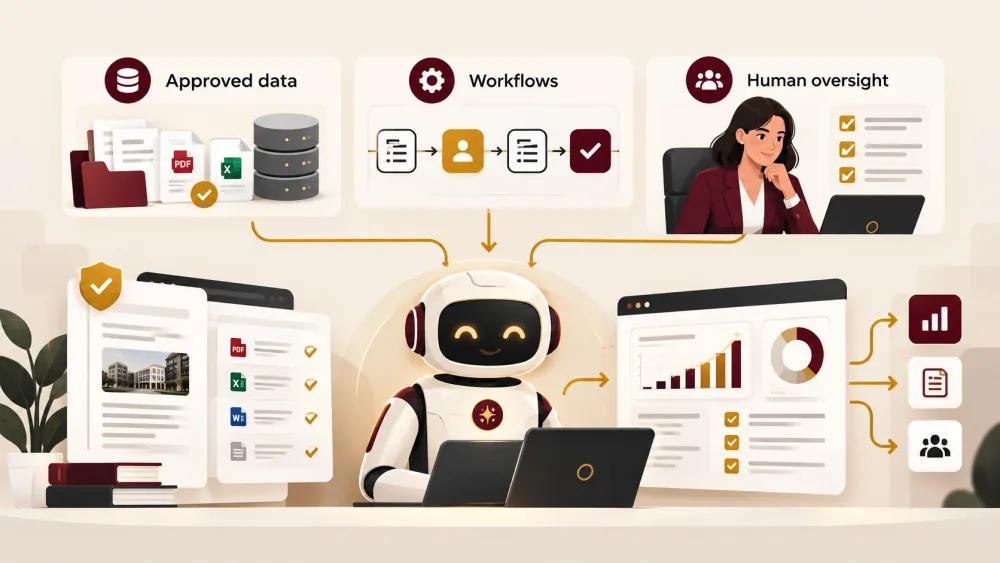
Your business knows how its work should be done. We help turn that knowledge into useful applications: finding information, supporting decisions and automating agreed steps. Describe the data, rules and outcome you need, and we can assess and build a solution around them with IntelliconAI, the software engineering business behind West Lothian IT.
Start with the business
The approach is not tied to one industry. A service business, retailer, manufacturer or office team may all benefit from better access to information and less repetitive work. You do not need a technical specification: explain what comes in, how a decision is made and what should happen next. Feasibility depends on data quality, access to your systems, risk and budget; not every problem needs AI.
RAG in plain English
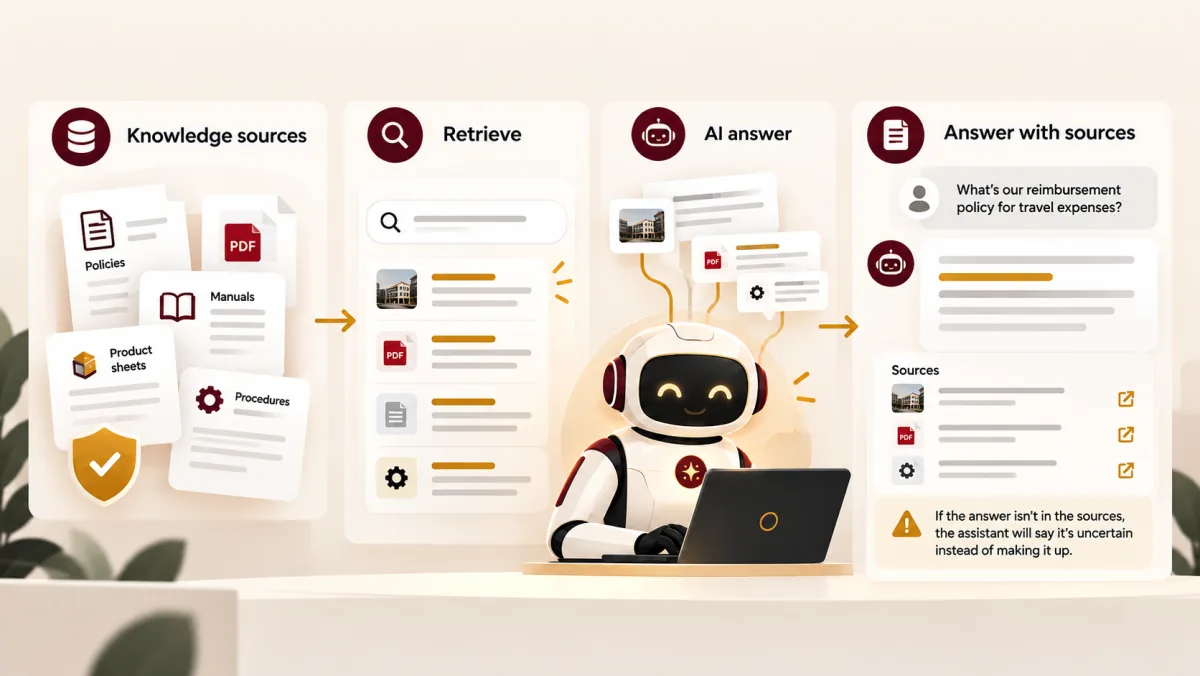
You define which policies, manuals, product information, procedures or other records the application may use. We agree permissions, ownership and how updates are handled.
Retrieval-augmented generation (RAG) searches those approved sources for information relevant to a question, then provides that material to the AI model as context. It is not the same as training a new model on all your data.
The application can show source references so staff can check an answer. It should flag missing evidence and escalate uncertainty rather than invent a confident response. RAG can improve grounding, but does not eliminate incorrect answers.
Illustrative possibilities
These are potential use cases, not claims of completed customer projects. Each needs discovery and testing against your actual business requirements.
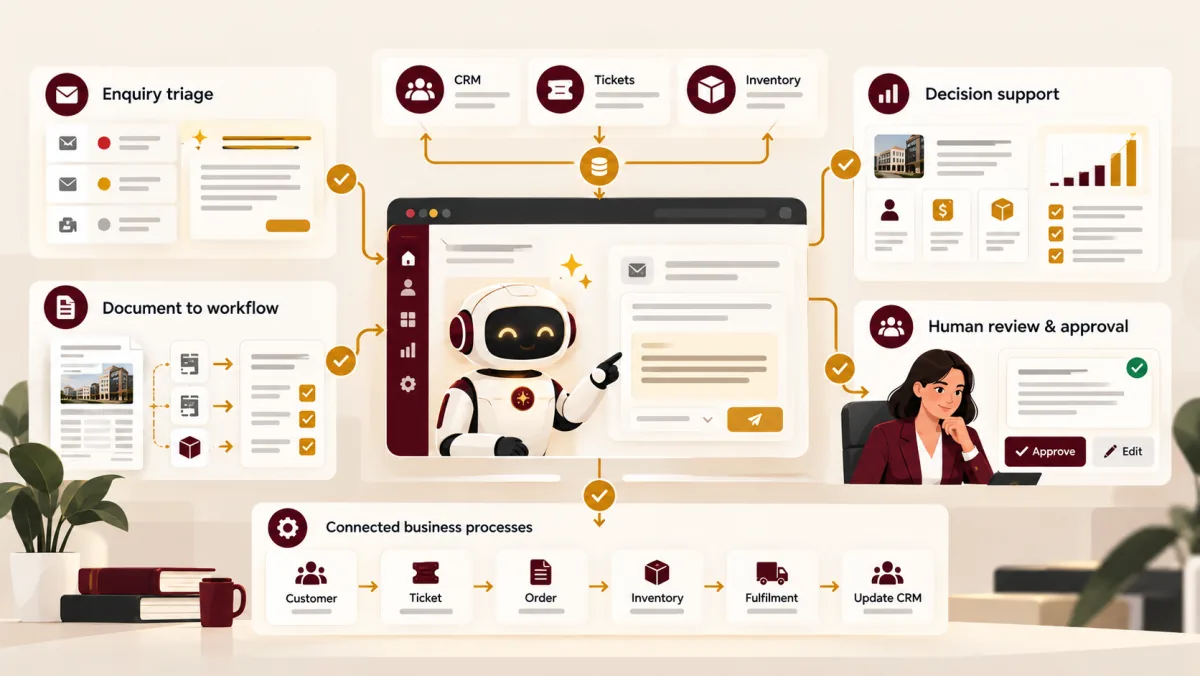
Help authorised staff find procedures, product details and policies, with links back to the source material.
Summarise requests, suggest a category and draft a response using approved guidance, ready for a team member to review.
Extract proposed fields from incoming documents, validate them against business rules and send exceptions to a person before updating a record.
Bring relevant records together, explain possible next steps and help staff compare options. Keep accountable people in control of consequential decisions.
Link agreed steps across CRM, ticketing, inventory or other systems where suitable APIs and permissions exist, reducing repeated entry and hand-offs.
Use explicit rules for predictable decisions and AI for tasks such as interpreting text. Do not replace a reliable calculation or approval rule with a model guess.
Data and control
Hosting and model choices are agreed before implementation. A hosted model may receive retrieved excerpts; a private or locally hosted model has different cost, hardware and maintenance requirements. We discuss what may leave your systems, provider data use, retention and access before connecting real business information.
Adopt AI in manageable stages
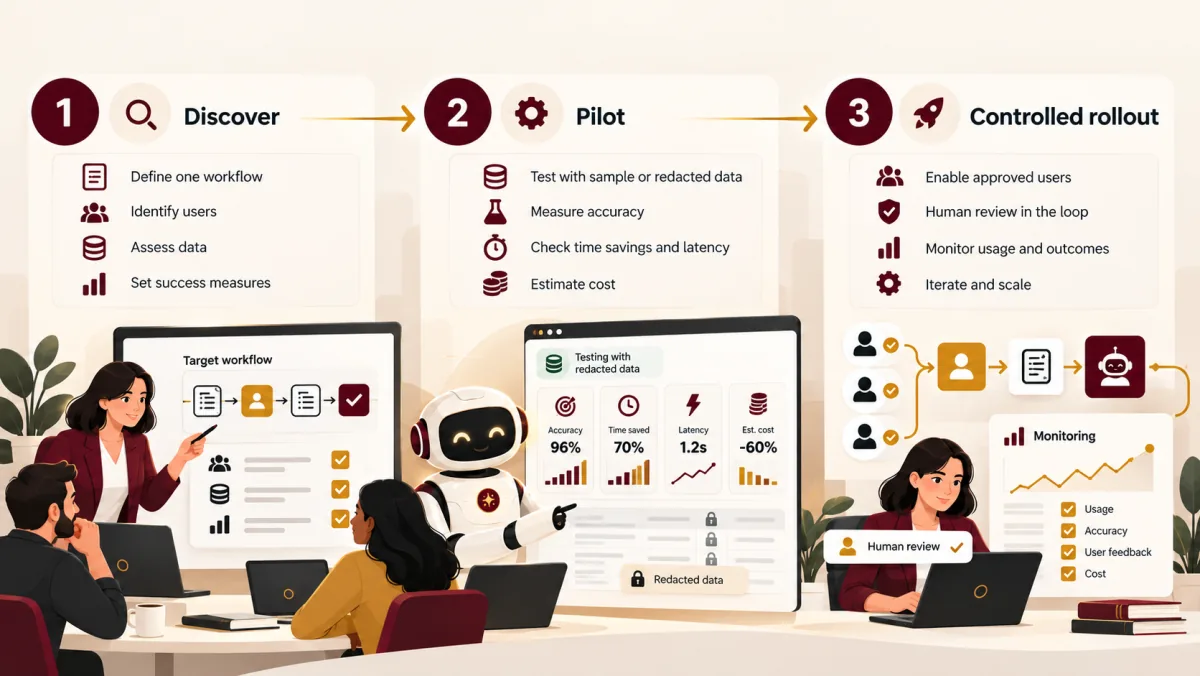
Choose one workflow and agree the users, permitted data, integrations, success measures and boundaries. Discuss development costs, ongoing model usage and hosting before commitment.
Start with sample or redacted data. Test representative questions, missing information, access restrictions and failure cases. Measure accuracy, staff time, latency and cost against the existing process.
Roll out to agreed users, with training and human approval where needed. Monitor results and expand only when the evidence supports it; the scope of any unattended actions is explicitly agreed.
Questions about AI adoption
Potentially, yes. We first assess formats, quality, permissions, source freshness and lawful use. Connected records may need structured queries or integrations rather than document search alone.
Low-risk, well-defined steps may be automated after testing. Decisions affecting people, finances, safety or legal obligations need appropriate safeguards, human review and specialist advice where required.
Yes: the starting point is a defined task, usable information and a measurable outcome, not a particular sector. Regulated and specialist use cases require additional assessment; no universal outcome is promised.
Describe one repetitive task, who does it, the systems involved and where delays or mistakes happen. Do not send credentials, customer records or confidential documents through the public chat or enquiry form.
From an idea to a scoped pilot
Tell Phil about the process, the information it relies on and the outcome you want. We will discuss what is feasible, what needs human oversight and how a focused application could help.